
by Nancy Thomas, commentary
A look at Crossroads Rhode Island’s 2024 compensation, public funding, and its winter shelter announcement raises questions about resources, results, and what happens to people still sleeping outside.
This November, those questions are immediate. Crossroads announced its winter shelter arrangements on Nov. 13. Meanwhile, a community advocate is urging coordinated help for people camping near its headquarters, who he understands face a Wednesday, Nov. 18, deadline to leave.
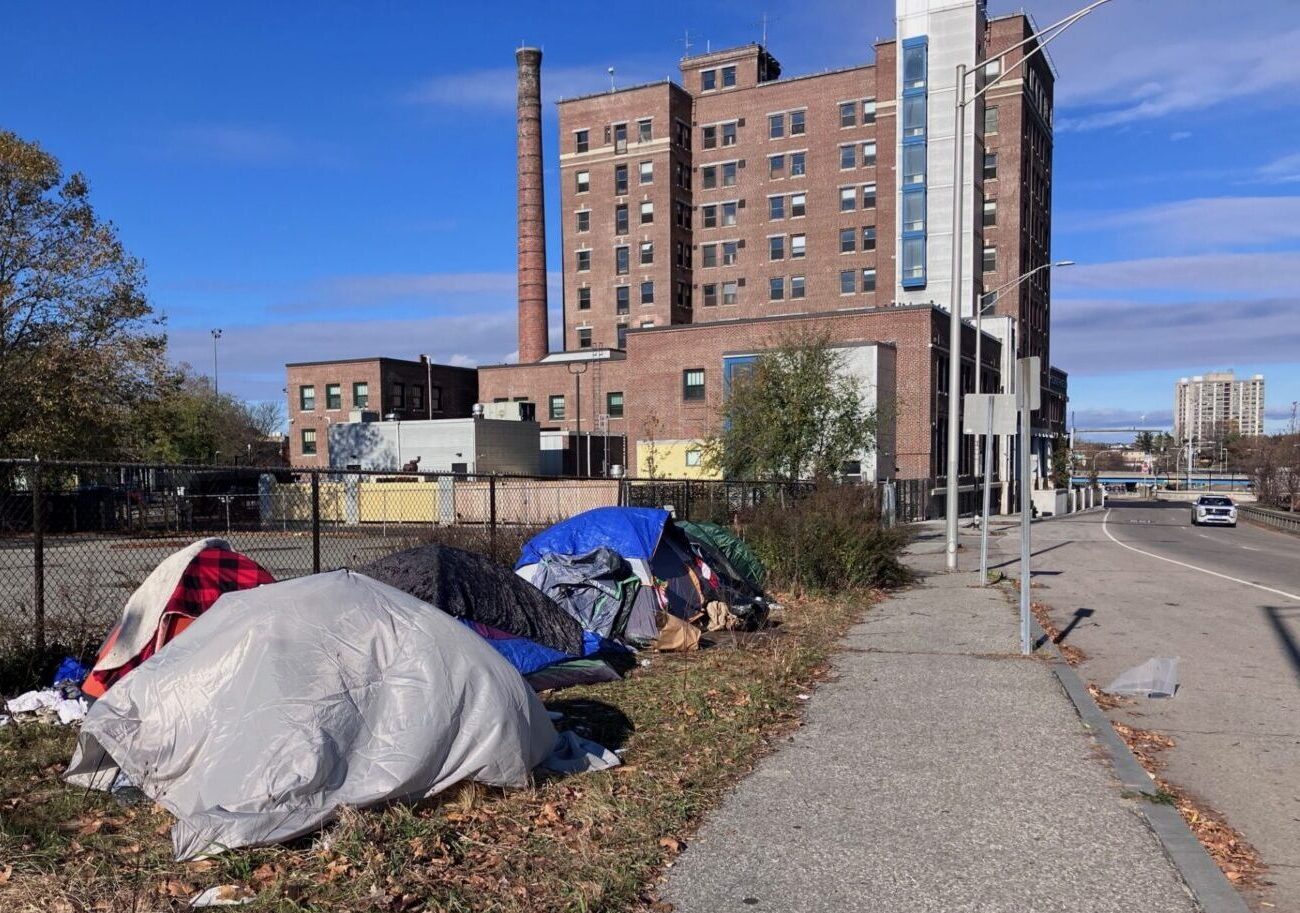
Sidewalk down the street from Crossroads, near 95 South on-ramp
What assistance is available? Who qualifies? And where can those people safely go?
In correspondence shared with RINewsToday, the advocate described speaking with an occupant who said no one had visited in some time and who did not recall receiving a notice to vacate.
That is one occupant’s account, relayed by the advocate. It does not establish that outreach had not occurred or that notices had not been delivered. The deadline and the agency issuing any notice remain to be independently confirmed.
The advocate urged Better Lives, Crossroads, and anyone else able to help to work together to find alternatives for the campers. He also asked that the effort be documented.
The practical question is whether each person facing displacement has been offered an available, appropriate place to go.
Incoming Providence Mayor Morales’ team representative was asked for the Mayor’s homeless plan, given that he will be taking office in January – dead center of the winter homeless time. Three requests, no response to date.
Crossroads Rhode Island reported $2,078,181 in compensation for 12 executives and senior staff in 2024, including retirement contributions, benefits, and other compensation. Four listed executives received total compensation exceeding $200,000.
The same federal tax return – 990 – reported $16,351,580 in government grants.
Those figures describe 2024, nearly two years ago—not current salaries. But they provide a documented starting point for examining the resources and leadership of an organization whose mission is to help people experiencing homelessness secure stable homes.
President and CEO Michelle Wilcox’s 2024 compensation totaled $352,962: $315,247 in base compensation, $32,340 in retirement and other deferred compensation, and $5,375 in nontaxable benefits.
The full group of paid executives and senior staff listed in the return received:
| Executive or senior staff member | Reportable compensation | Other compensation* | Total |
|---|---|---|---|
| Michelle Wilcox — President & CEO | $315,247 | $37,715 | $352,962 |
| Merelise Hitte — Chief Financial Officer | $248,612 | $15,684 | $264,296 |
| Laura Calenda — Chief Philanthropy Officer | $206,038 | $8,339 | $214,377 |
| John MacDonald — Chief Program Officer | $177,873 | $25,001 | $202,874 |
| Gordon Fox — Chief Asset Development Officer | $149,353 | $14,165 | $163,518 |
| Jennifer Watkins — VP Shelter Services | $124,985 | $22,988 | $147,973 |
| Marcia Marino — VP Finance | $134,112 | $5,720 | $139,832 |
| Jenna Nutting — VP Supportive Services | $127,429 | $11,094 | $138,523 |
| Monica Spicer — VP Housing Assets | $127,718 | $9,820 | $137,538 |
| Karen Santilli — CEO through February | $108,844 | $23,843 | $132,687 |
| Greg Amoroso — VP Human Resources | $120,905 | $5,204 | $126,109 |
| Jennifer Schanck-Bolwell — COO beginning September | $55,266 | $2,226 | $57,492 |
| Total | $1,896,382 | $181,799 | $2,078,181 |
Other compensation includes retirement and benefits. This is the listed leadership group, not the entire workforce. Partial-year amounts are not annual salary rates.
Schedule J reports no bonuses or incentive compensation for the five executives individually detailed there.
The figures compiled for Karen Santilli and Michelle Wilcox show combined reportable compensation above half a million dollars annually from 2021 through 2023, before separately reported benefits and other compensation.
| Year | Karen Santilli | Michelle Wilcox | Combined |
|---|---|---|---|
| 2021 | $202,520 | $307,900 | $510,420 |
| 2022 | $323,378 | $226,790 | $550,168 |
| 2023 | $343,797 | $242,133 | $585,930 |
| 2024 | $108,844 | $315,247 | $424,091 |
Santilli departed (on paper) in February 2024; Wilcox subsequently became President & CEO. The lower combined amount that year reflects a leadership transition.
Crossroads’ 2024 return self-reports the following activity:
| Service | Reported 2024 activity |
|---|---|
| Emergency shelter | Nearly 1,600 people, including 132 children and 100 seniors over 65 |
| Housing programs | More than 2,500 people whom Crossroads says it helped end their homelessness |
| Housing problem solving | More than 2,200 “at-risk individuals and families” helped prevent or quickly end homelessness |
| Education and employment | 204 participants, with 67 finding new employment |
These categories may overlap and cannot be added together to produce a count of distinct people served.
The return also reports operating five shelters with more than 200 beds and owning and managing more than 375 permanent supportive apartments statewide.
Those services are substantial. So are the resources entrusted to the organization.
Crossroads reported $16.35 million in government grants within $25.48 million in total contributions and grants in 2024. The government category can include multiple levels of government; it is not exclusively Rhode Island state funding.
Crossroads says a five-member compensation committee reviews comparable compensation data, evaluates the President/CEO against organizational goals, and recommends salary action to the board. Its review also considers responsibility for three low-income housing tax credit partnerships.
That describes the process. The filing does not identify the comparison organizations, salary ranges, or specific performance findings supporting the reported amounts.
Those details would help the public assess how compensation decisions connect to responsibilities and results.
In its November 13 announcement, Crossroads said its 24/7 emergency winter shelter was open.
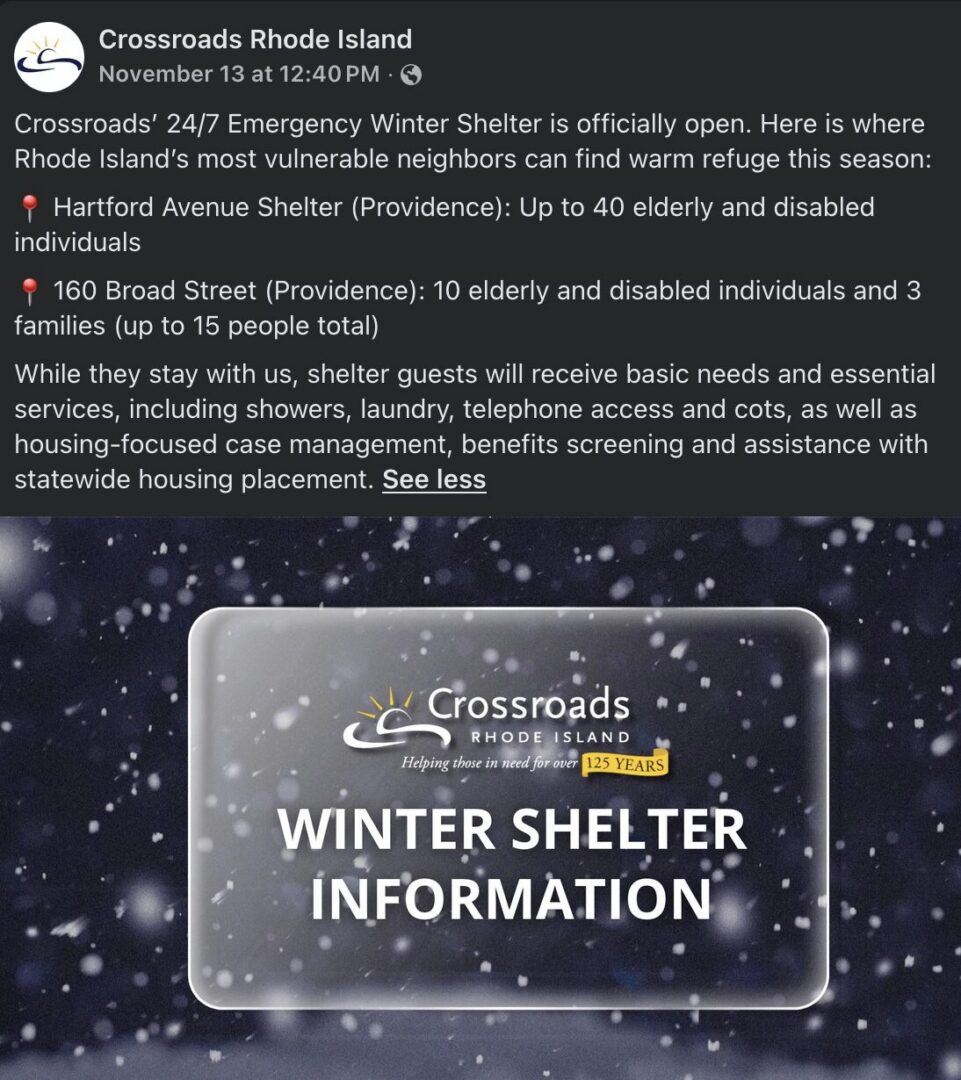
The announcement lists:
The Broad Street wording does not clearly establish whether the 15-person limit applies to the families alone or the entire allocation at that location.
Crossroads said guests would receive cots, showers, laundry and telephone access, along with housing-focused case management, benefits screening, and housing-placement assistance.
The post did not explain where single adults outside the elderly and disabled categories could obtain winter shelter, how many spaces remained available, or what would happen once the listed locations were full.
Last year people who came in for emergency shelter could only have one bag to take in with them – at least two men we were aware of chose to leave – with their belongings – and sleep under the Waterplace area.
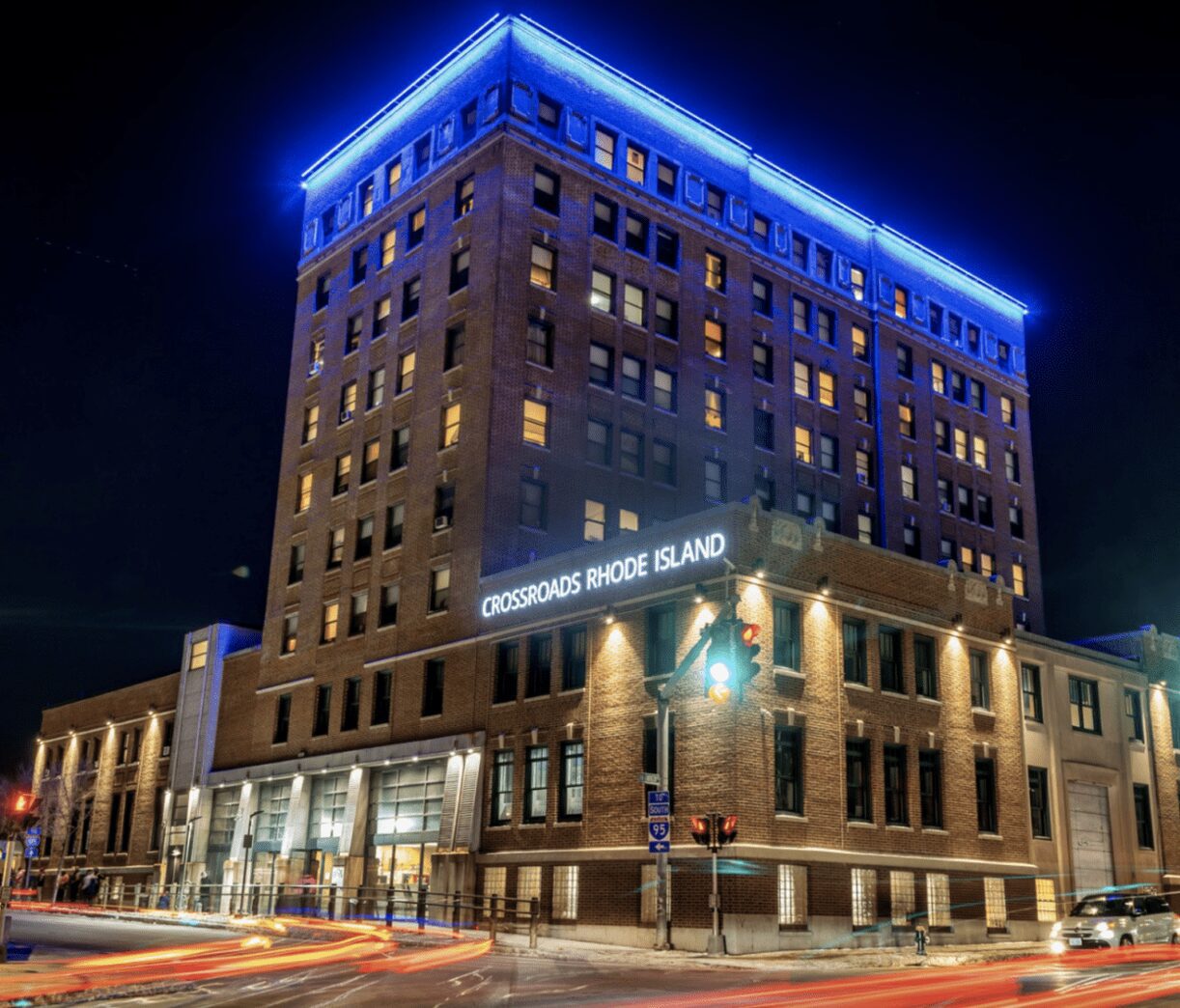 Questions about spending priorities are not new.
In March 2025, RINewsToday reported a $685,000 lighting project at Crossroads’ 160 Broad Street building, including the prominent rooftop LED installation.
The contractor later clarified that its work also included comprehensive wiring, street-lighting improvements, and signage. Crossroads said the lighting was competitively bid as a package, that a separate decorative-lighting cost was unavailable, and that private grants and contributions funded the exterior work.
The entire amount therefore cannot be attributed solely to rooftop decoration, and the capital funding should not be treated as money necessarily available for shelter operations.
But the public can still ask how those priorities were established and what the decorative component cost.
During that reporting, Crossroads responded through communications consultant Mike Raia, who provided information about bidding and funding before stating: “We will have no further comments on this and we are moving on to other more pressing priorities.”
That was the response to the lighting inquiry in 2025. The records reviewed for this article leave additional questions unanswered about compensation benchmarks, performance measures, and available placements for people now living outside.
It should be noted that repeated attempts to get more detailed information from Crossroads have gone unanswered, with direction being given to their website, which has little functional information on it.
When Governor-elect Helena Foulkes announced her transition team, she spoke about serving meals to people experiencing homelessness at Mathewson Street. Her voice began to break, and she appeared close to tears.
The people she described are the reason these questions matter.
Crossroads’ financial disclosures document substantial leadership compensation. Its service figures document substantial work. Neither eliminates the need to account for what happens to someone still sleeping outside its doors.
The incoming administration has an opportunity to establish clear expectations for publicly supported homeless services: understandable spending reports, measurable results, coordination among providers, and documentation of the assistance offered when people are told to leave an encampment.
For those facing the reported November 18 deadline, the need comes before a new administration takes office. The responsibility to respond now rests with the officials and providers already in place.
But Foulkes can use the transition to make clear what her administration will expect—and listen directly to people whose experiences may not be captured in an annual report.
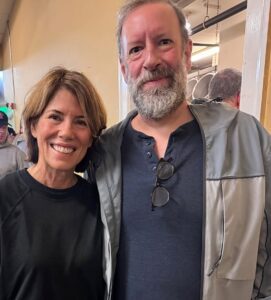
Gov-elect Foulkes and Kevin Bacon, Mathewson St. program
Serving a meal offers an opportunity to hear someone’s story. Leading a state offers an opportunity to change what happens next.
This is a moment to turn concern into accountability—and a path indoors.
The post Homeless in RI: Crossroads. The Lights Are On. This Is a Moment for Change. appeared first on RINewsToday.


